Zeiss
Merlin
Zeiss MERLIN is a scanning electron microscope at CMi. Zeiss MERLIN has a GEMINI II column and a 5-axis motorized stage. Zeiss MERLIN supports a full 4 inch wafer holder.[1]
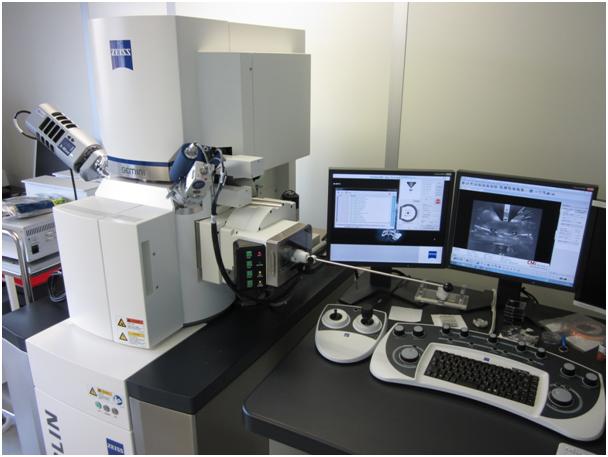
Plate 01VOLK MERLIN on Zeiss microscope
Facundo BWatch on YouTubePlate 02ZEISS MERLIN 3View and SIGMA VP 3View - SBF-SEM/SBEM Workflow Animation
ZEISS MicroscopyWatch on YouTubePlate 03SEM EDX analysis using Zeiss Merlin equipment | Full version
Ahror IsmoiliWatch on YouTube
Wafer size
4"
Optics
GEMINI II[1]
How it works
The Zeiss Merlin uses a GEMINI II column with a Schottky field emitter as the electron source. The emitted electrons are accelerated by an acceleration voltage, and a beam booster maintains high electron energy throughout the column to reduce sensitivity to magnetic stray fields and minimize beam broadening.[1]
The column can be operated in different modes, including high-resolution, analyzer, and depth-of-field modes, which adjust condenser excitations and aperture settings to optimize imaging for different applications. The microscope is controlled via the ZeissSmartSEM software through a graphical user interface, with a dual joystick for stage control and a keyboard control panel for direct access to frequently used functions.[1]
The system is fitted with three detectors: an In-Lens detector for high-resolution secondary electron imaging, a HE-SE2 Everhart-Thornley detector for topography, and an EsB in-column detector with filtering grid for pure material contrast. The specimen stage is eucentric with five axes (X, Y, Z, tilt, rotation), ensuring focus is maintained during tilting.[1]
Applications
The detectors enable imaging of secondary and backscattered electrons, and the instrument can perform energy-dispersive X-ray analysis with additional training. The system is suitable for examining various materials, including non-conductive samples and polymers, using appropriate detector settings.[1]
- Imaging for process control
- Offline analysis and metrology
- Elemental compositional analysis by EDX
What do the numbers mean?
Wafer handling5
Optics & imaging9
Control & software3
Configuration & options5
What replaced it?
Related models
- siblingZeiss Leo 1550— Listed in the same equipment section as Zeiss MERLIN.source[1]
- siblingZeiss CrossBeam 550— The basic training notes differences between the SEM Crossbeam and SEM MERLIN, and state that being fully trained on SEM MERLIN is a prerequisite.source[2]
Where are the manuals?
Generated from public-source data on file. Enter your email to access — nothing is published; details are routed privately.
Not publicly documented
Field notes
No research found yet — worked with this tool? Share what you know.
Frequently asked questions
What column does the Zeiss Merlin use?
The Zeiss Merlin uses a GEMINI II column with a Schottky field emitter and a combined electrostatic/electromagnetic lens doublet.[1]
What stage does the Zeiss Merlin have?
The stage is motorized with five axes (X, Y, Z, tilt, rotation) and is eucentric, meaning all rotation axes intersect at a single point.[1]
What detectors are available on the Zeiss Merlin?
Three detectors are fitted: an In-Lens detector for high-resolution SE imaging, a HE-SE2 Everhart-Thornley detector for topography, and an EsB with filtering grid for pure material contrast.[1]
Can the Zeiss Merlin perform EDX analysis?
EDX analysis is possible after additional training, and it requires full confirmation of SEM imaging first.[1]
What software controls the Zeiss Merlin?
The microscope is controlled by the ZeissSmartSEM software via a graphical user interface.[1]
Not publicly documented
The following facts about the Merlin are absent from this record as of this revision. First-hand knowledge or a citation closes a gap; every submission is reviewed before publication.
No publicly documented production dates or lifecycle milestones (introduction, end of production, EOL) for the Merlin are on record.
Answerable by: OEM historical records or a trade-press announcement
No publicly documented variants, configuration options, or revision breakpoints of the Merlin are on record.
Answerable by: an OEM product catalog or an engineer who ordered or specified the tool
The control-system platform and OS era of the Merlin are not on record.
Answerable by: an engineer who operated it or OEM installation records
No publicly documented failure modes or field errata for the Merlin are on record.
Answerable by: a field service engineer, process engineer, or maintenance technician
The process node or technology generation of the Merlin is not on record.
Answerable by: an OEM datasheet or a fab qualification report
No research found yet — worked with this tool? Share what you know.
Sources & citations
Sources (3)Every fact above is drawn from these public sources
- [1]epfl.ch — epfl.chepfl.ch
- [2]epfl.chepfl.ch
- [3]Capabilities | UD Nanofabrication Facility — udnf.udel.eduudnf.udel.edu
Last updated Oct 8, 2026.
Compare with similar tools
View all →The Zeiss LEO 1550 is a scanning electron microscope listed in the FIB / SEM / EDX / ProSEM section. The Zeiss LEO 1550 is associated with SEM imaging and sample holders for 4 inch wafers, 6 inch wafers, and 6 inch masks.

The Hitachi SU 8030 FEG-SEM is a field emission gun scanning electron microscope.
The KLA .204 PSL Wafer is an 8-inch NIST-traceable reference wafer compatible with Surfscan 6xy0 and Sp1 particle counters.
KLA .496 PSL Wafer is an 8-inch NIST traceable wafer stated to be capable on Surfscan 6xy0 and SP1.
