SPTS
uEtch
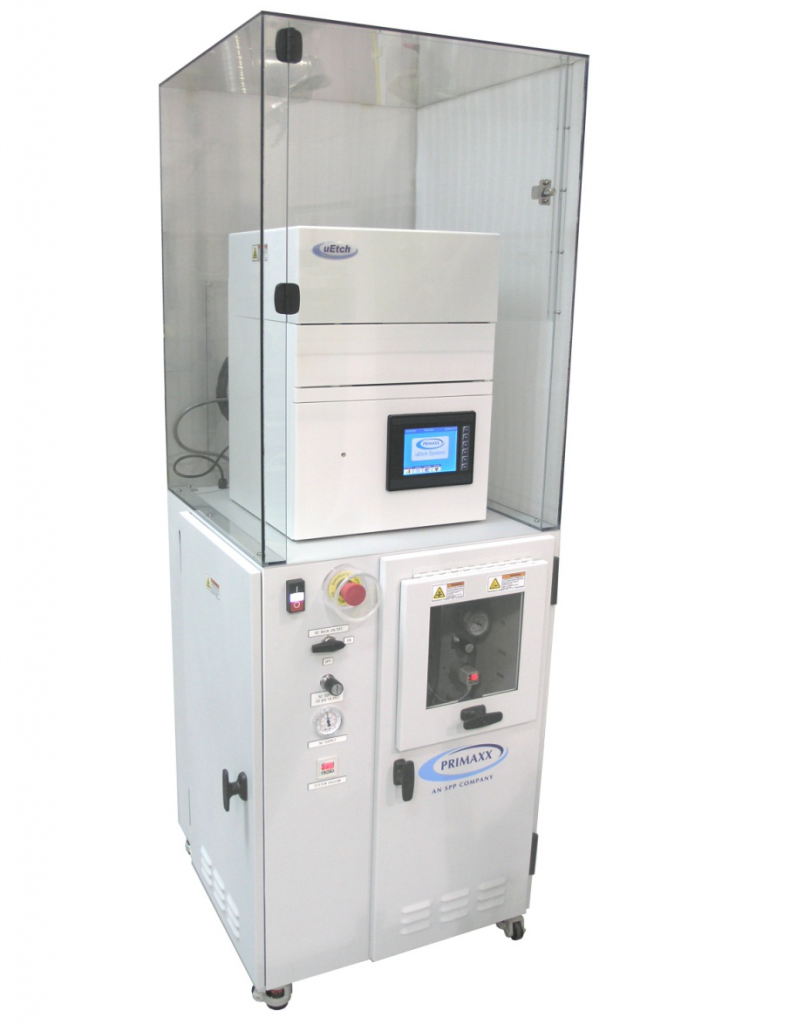
The SPTS uEtch is a vapor-phase selective isotropic etch tool for sacrificial oxide release. The SPTS uEtch uses reduced-pressure gas-phase anhydrous HF, ethanol, and nitrogen to etch sacrificial SiO2. The SPTS uEtch has five standard processes at a fixed total pressure of 125 Torr.[1]
Vacuum
125 Torr fixed for the standard processes[1]
Gas delivery
Anhydrous HF, ethanol vapor, N2[1]
Optics
12 nm/min[1]
What it is
The SPTS uEtch is a vapor-phase etching system designed for selective, isotropic removal of sacrificial silicon dioxide. The tool is used for releasing microelectromechanical (MEMS) devices by etching away the oxide layer without contacting the structures with liquids.[1]
How it works
The process is isotropic and selective to thermal oxide, though low-temperature deposited oxides (LPCVD, PECVD, ALD, evaporated, sputtered) etch faster. Etch rate also depends on the total exposed SiO2 area in the chamber (macro-loading effect). The tool is typically operated by loading a wafer, selecting a recipe, and running etch cycles with a user-set duration.[1]
Where it fits in the process flow
General reference — not yet source-verifiedThe SPTS uEtch is used in MEMS fabrication after the deposition and patterning of a sacrificial oxide layer and the overlying structural layer. The tool is employed to selectively remove the sacrificial oxide, freeing the movable microstructures. The release step is typically the final wet or dry step before any critical-point drying or packaging.
Upstream process steps include chemical vapor deposition of the sacrificial oxide, deposition of the structural material (such as polysilicon), and photolithographic patterning. Downstream, the released devices may undergo supercritical drying or other drying methods to prevent stiction, though the vapor-phase process itself eliminates liquid contact.
Applications
The primary application of the SPTS uEtch is the release of MEMS devices that require free-standing structures, such as suspended membranes, cantilevers, and inertial sensors. The tool can produce clean, residue-free releases for polysilicon microstructures, as demonstrated by suspended polysilicon membranes etched with a high-HF recipe.[1]
- Sacrificial SiO2 etching for MEMS release
Why won't it start?
Documented failure modes, common issues, and field considerations.
- Some materials are not compatible with the tool, including polymers (PR, Quickstick, Tape), soda-lime (float glass), Borofloat, Ge, Ti, TiN, Ta, TaN, TaOxide, and silicon nitride (subject to exceptions).
What do the numbers mean?
Vacuum & pumping6
Wafer handling2
Gas & chemistry5
- Etch chemistry
- Vapor-phase HF with ethanol catalyst, selective to SiO2 over Si and other materials[1]
Optics & imaging25
Control & software1
Configuration & options6
What does it need to run?
Site utility requirements, footprint, and infrastructure needed to install and operate this tool. Sourced from public records.
- Process chemistryAnhydrous HF and ethanol (C2H5OH) with nitrogen (N2) gas mixture[1]
- Operating pressure125 Torr fixed for the standard processes[1]
- Total pressure125 Torr (fixed for standard processes)[1]
- Chamber pressure range (manual needle valve)75–150 Torr[1]
- Gases usedAnhydrous HF, ethanol (C2H5OH) vapor, nitrogen (N2)[1]
- Total process pressure125 Torr[1]
- Process pressure125 Torr (fixed for all standard processes)[1]
- Process gasesAnhydrous HF, ethanol vapor, N2[1]
- Etch chemistryVapor-phase HF with ethanol catalyst, selective to SiO2 over Si and other materials[1]
- Etch chemistryAnhydrous HF and ethanol with nitrogen[1]
- Total pressure125 Torr[1]
Where are the manuals?
Generated from public-source data on file. Enter your email to access — nothing is published; details are routed privately.
Not publicly documented
Field notes
No research found yet — worked with this tool? Share what you know.
Frequently asked questions
What materials are incompatible with the SPTS uEtch?
The following materials are known to be incompatible: polymers (PR, Quickstick, Tape, etc.), soda-lime glass, Borofloat, germanium, titanium, titanium nitride, tantalum, tantalum nitride, tantalum oxide, and silicon nitride (subject to exceptions). Users should ask staff about materials compatibility before processing.[1]
What are the standard process recipes and their etch rates?
Five standard processes are offered, all at a total pressure of 125 Torr. The minimum etch rates for thermal oxide are: Recipe1 - 12 nm/min, Recipe2 - 38 nm/min, Recipe3 - 125 nm/min, Recipe4 - 153 nm/min, Recipe5 - 175 nm/min. Low-temperature deposited oxides etch faster.[1]
What is the role of ethanol in the VHF process?
Ethanol acts as a catalyst; it is not consumed in the reaction. Without ethanol, SiO2 etching will not occur. Ethanol also helps keep the wafer surface dry, allowing reaction by-products to be pumped away and preventing stiction from generated water vapor.[1]
Can the tool etch materials other than thermal oxide?
Yes, low-temperature deposited oxides such as LPCVD, PECVD, ALD, evaporated, and sputtered oxides will etch faster than thermal oxide. The etch rate also depends on the total exposed SiO2 area in the chamber (macro-loading effect).[1]
Not publicly documented
The following facts about the uEtch are absent from this record as of this revision. First-hand knowledge or a citation closes a gap; every submission is reviewed before publication.
No publicly documented production dates or lifecycle milestones (introduction, end of production, EOL) for the uEtch are on record.
Answerable by: OEM historical records or a trade-press announcement
No publicly documented variants, configuration options, or revision breakpoints of the uEtch are on record.
Answerable by: an OEM product catalog or an engineer who ordered or specified the tool
The control-system platform and OS era of the uEtch are not on record.
Answerable by: an engineer who operated it or OEM installation records
The process node or technology generation of the uEtch is not on record.
Answerable by: an OEM datasheet or a fab qualification report
No publicly documented compatible parts, consumables, or accessories for the uEtch are on record.
Answerable by: an OEM parts catalog or a service engineer
Sources & citations
Sources (3)Every fact above is drawn from these public sources
- [1]epfl.ch — epfl.chepfl.ch
- [2]Vapor Etching | Stanford Nanofabrication Facility — snfguide.stanford.edusnfguide.stanford.edu
- [3]SPTS Primaxx uEtch for HF vapor release etch for MEMS — spts.com (May 5, 2018)web.archive.org
Last updated Oct 8, 2026.
Compare with similar tools
View all →The Applied Materials 0010-47763 is an electrostatic chuck (ESC) assembly used in semiconductor etching processes.
The Applied Materials 0010-16392 is an electrostatic chuck assembly designed for 300 mm wafer processing, featuring a dual electrode configuration.
Oxford Instruments 100 ICP Fluorine is an inductively coupled plasma etcher for fluorine-based etching, supporting cryo DRIE and multiple etch gases including SF6 and C4F8.
